
The Nürnberger Rostbratwurst has held EU Protected Geographical Indication (PGI) status since 2003. It may only be produced within Nuremberg city limits according to the registered specification. Typical features are 7 to 9 cm length, 20 to 25 g weight, sheep casing and marjoram seasoning. It is eaten as Drei im Weggla or served traditionally on a plate with sauerkraut, potato salad, horseradish and bread.

Franconia has enormous Bratwurst variety. Each region, many butchers and some inns have their own version: coarse or fine, long or short, seasoned with marjoram, pepper, nutmeg, caraway or wine. The Nürnberger Rostbratwurst is among the best known. Its geographical origin is legally protected, and its history is closely tied to Nuremberg's food culture.
What the Nürnberger Rostbratwurst Is
The Nürnberger Rostbratwurst is small: 7 to 9 cm long and about 20 to 25 g in weight. It is made from pork, salt, pepper and the characteristic marjoram seasoning. The texture is medium-coarse, the casing is sheep casing. Traditionally, it is grilled on a rack over beechwood fire.
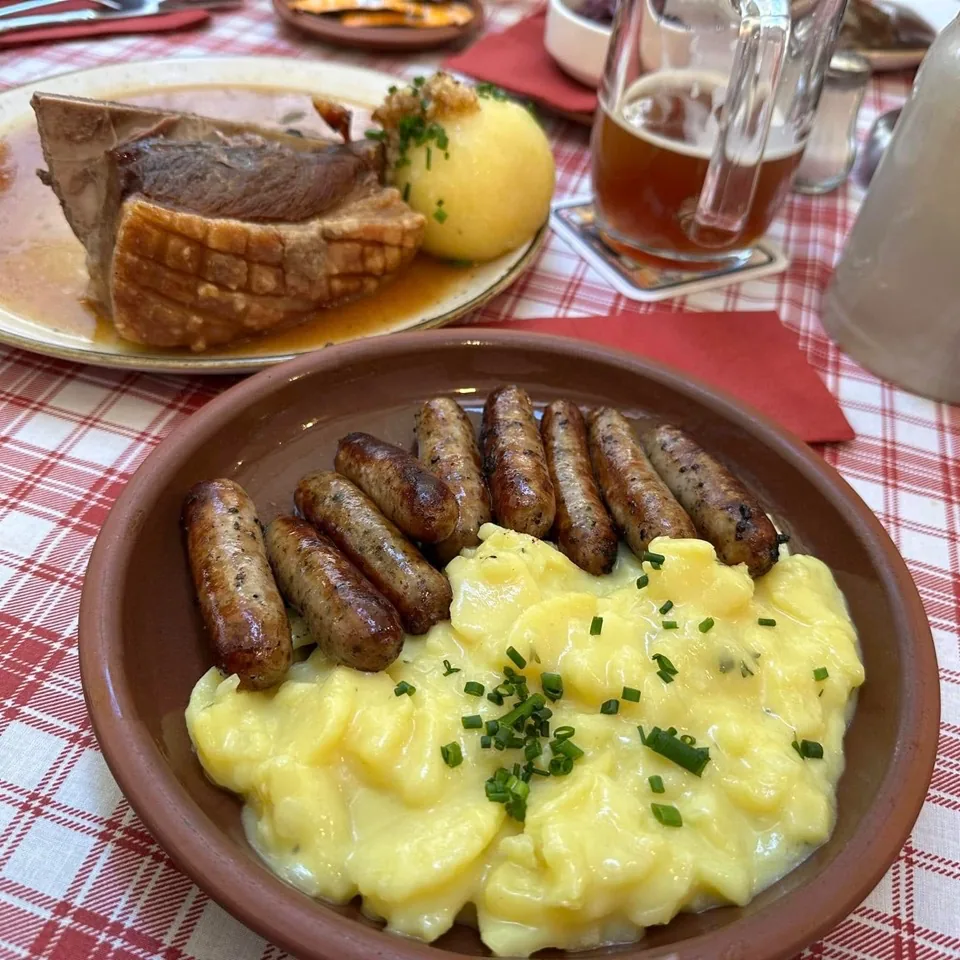
The result is a small, well-seasoned, lightly smoky sausage with a short, intense crust. That combination is what separates it from generic small supermarket sausages.
The Protected Geographical Indication
The Nürnberger Rostbratwurst carries the EU label PGI, Protected Geographical Indication. This means it may only be produced within the city limits of Nuremberg and must follow the defined specification. Not in the surrounding district, not somewhere in the metropolitan region, only inside the city of Nuremberg.
Important: the word "Rostbratwurst" alone is not protected. The protected names are Nürnberger Bratwürste and Nürnberger Rostbratwürste. Other producers may make small grilled sausages, but they may not present them as Nürnberger.
This protection is not just marketing. It keeps the Nürnberger Rostbratwurst a distinct product with clear origin, recipe and quality control.
The History
The Nuremberg bratwurst has been part of the city for centuries. As early as 1313, the Nuremberg council was concerned with the quality of the city's bratwurst. That fits the city's history: Nuremberg was a wealthy trading city with strict food rules and a strong craft tradition.
Many legends surround the small size, including the story that the sausages were passed through keyholes. It is a good story, but not the core of the history. What matters is that the Nürnberger Rostbratwurst was maintained, regulated and passed down as a local craft product for centuries.
How to Eat It
Nuremberg has two classic ways of serving it.
Drei im Weggla
Three Nürnberger Rostbratwürste in a bread roll, the "Weggla", with mustard. This is Nuremberg's street food. You find it at bratwurst stands in the old town, around the Hauptmarkt, near the Rathausplatz and wherever charcoal smoke is in the air.
Drei im Weggla is quick, affordable, satisfying and perfect after a Rotbier at the Altstadthof or during a walk through the old town.
On a Pewter Plate
The classic sit-down version is served in Nuremberg's Bratwurstküchen. The sausages arrive in several portion sizes; the menu of the particular house gives them. The classic sides are sauerkraut or potato salad, horseradish and bread.
This is the complete Nuremberg bratwurst meal. No decoration, no sauce, no modern garnish. Sausages, kraut or salad, horseradish, bread. That is the traditional combination.
Common serving styles
- Drei im Weggla: three grilled sausages in a bread roll with mustard.
- At a Bratwurstküche: grilled sausages on pewter with sauerkraut or potato salad, horseradish and bread.
- Saure or Blaue Zipfel: poached in an onion-and-vinegar broth.
- Portion size: the number of sausages and sides follows the menu of the particular restaurant.
Where in Nuremberg?
The best-known address is the Bratwursthäusle at Rathausplatz, right by the Hauptmarkt. It is not a hidden institution, but it is one of the classic addresses for Nürnberger Rostbratwürste from the beechwood grill.
There are also several traditional Bratwurstküchen and stands in the old town. Good signs: charcoal smell, grill rather than pan, Original Nürnberger Rostbratwürste and classic sides such as sauerkraut, potato salad and horseradish.
Franconian Bratwurst Variety
The Nürnberger Rostbratwurst is the famous one, but not the only Franconian Bratwurst. Coburg has a large bratwurst traditionally grilled over pine cones. Kulmbach has its own fine bratwurst tradition. Ansbach, Bayreuth, Würzburg, Hof and many villages have their own variants too.
That is typical Franconia: local independence over standardisation. The Nürnberger is only the most famous form of a much broader bratwurst culture.
What to Drink with It?
A Nuremberg Rotbier works especially well with Nürnberger Rostbratwurst. The malt character of the beer fits the marjoram seasoning and grilled crust. A Helles or Kellerbier also works. The main rule is simple: drink local, do not overthink it.